Relationship guide • Updated September 14, 2026
Tomodachi Life Relationship Levels: Statuses & Tips
Short answer: Tomodachi Life relationship levels are best read as a combination of the visible status and the recent history of the bond. Friend, sweetheart, spouse, family member, and ex describe relationship states; the meter, dialogue, and events help you judge whether a bond is growing or strained. This guide maps the common states and gives repeatable ways to improve Mii relationships without APKs, ROMs, save files, or mystery compatibility claims.
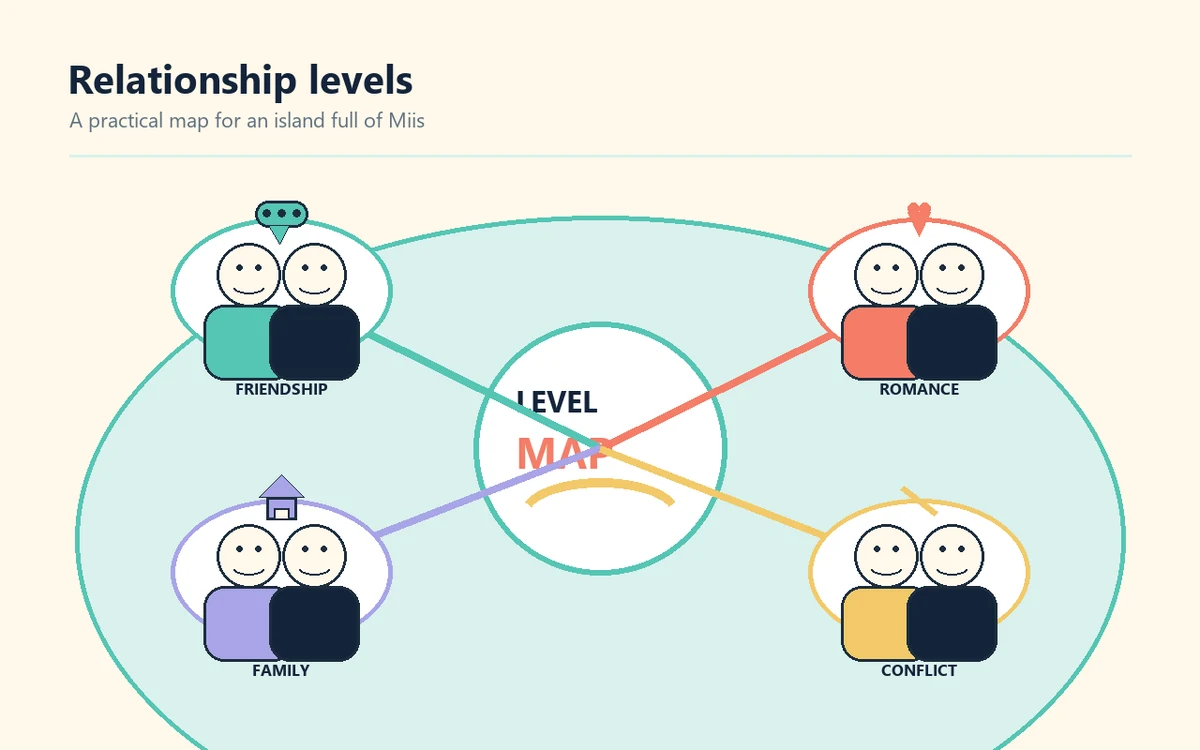
Status is not a numbered score
Friend, sweetheart, spouse, family, and ex describe a state. They are not a universal public 1–10 chart for every title or language.
Read the context
Recent conversations, requests, gifts, arguments, and life events help explain why a bond feels stable, active, or fragile.
Improve patiently
Respond to the Mii's current need, observe the reaction, and leave room between experiments instead of spamming one action.
Tomodachi Life Relationship Levels Explained
Searchers usually want two answers: what a relationship label means and what to do next. The chart below is a practical ladder, not a leaked numeric formula. Exact wording and prompts can vary by title, translation, and island situation. A stronger status does not guarantee that two Miis will never argue, while a short setback does not always mean the relationship is over.
| Practical level | Status examples | Meaning | Next move |
|---|---|---|---|
| New or fragile | Acquaintance | Little shared history | Observe and respond |
| Friendly | Friend | Positive everyday bond | Visit or choose a fitting activity |
| Close friendship | Best friend | More history and personal requests | Protect the routine and listen |
| Romantic | Sweetheart | Romance is being recognized | Use the marriage guide for proposals |
| Committed or strained | Spouse, family, ex, argument | A major event changed the state | Read the event, then repair or give space |
Relationship Status vs. Relationship Level
Relationship status usually means the label shown for a pair. Relationship level is a player-friendly description of how developed or secure that connection feels. They overlap, but they are not identical: a positive status can still need attention, and an argument can change the mood before the label changes. This distinction keeps you from searching for one hidden number that supposedly explains every friendship, proposal, and family event.
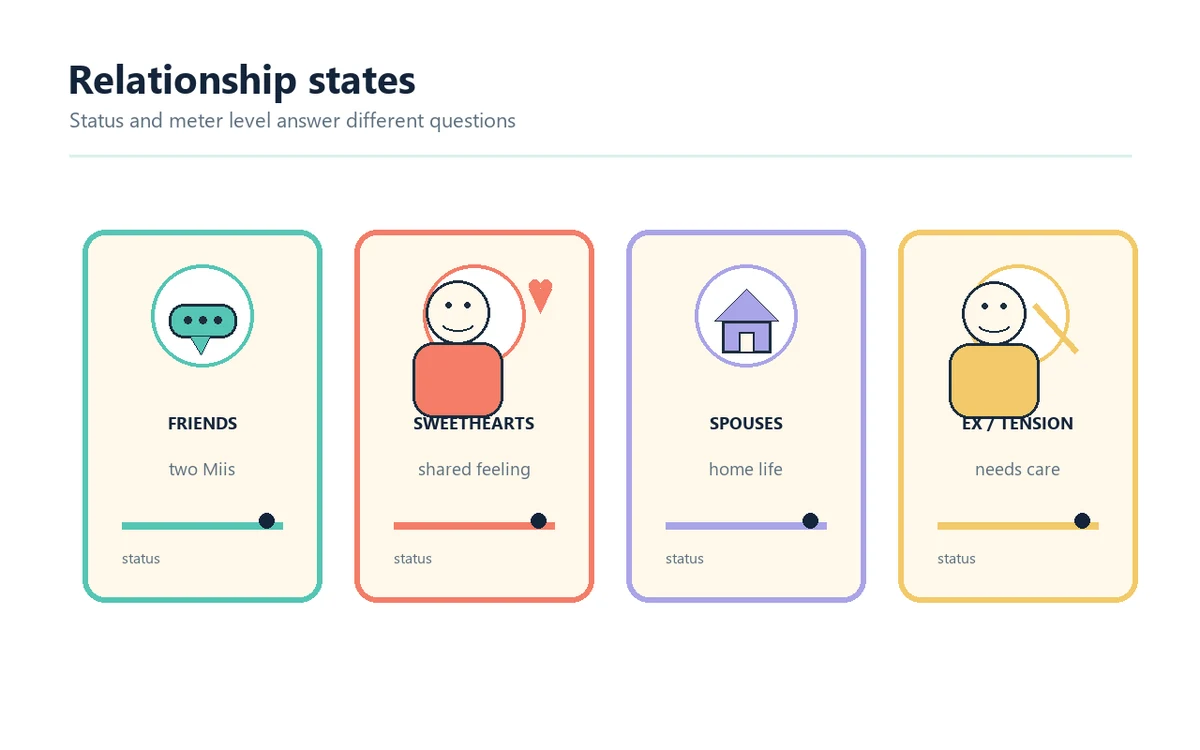
Label changes
The game is signaling a different state. Ask what event happened immediately before it changed.
Meter feels low
The bond may be fragile or recently affected. One random gift is not a guaranteed reset.
Romantic prompt
Romance is present, but a prompt does not promise a successful proposal or marriage.
Argument appears
The bond needs repair or space. Treat the cause and reaction as evidence, not a permanent verdict.
How to Improve Mii Relationships in Tomodachi Life
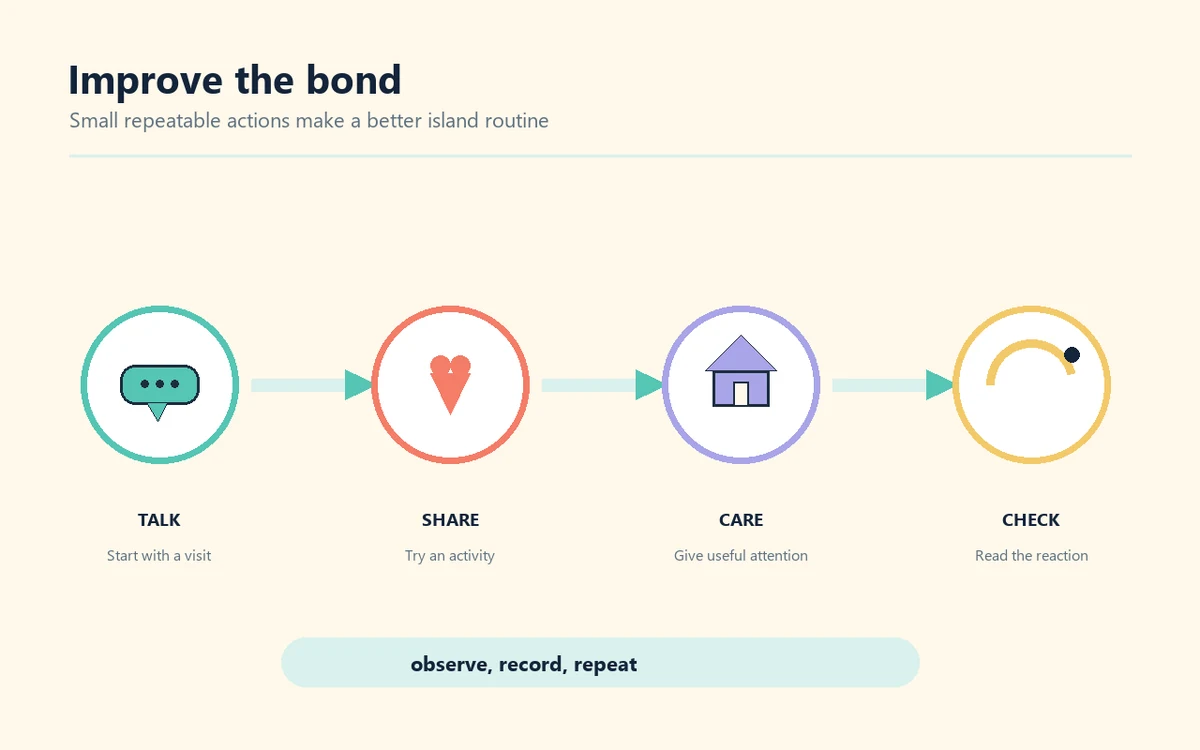
There is no single guaranteed button for raising every relationship. A reliable routine is a small experiment: note the current state, choose an appropriate interaction, watch the response, and return later. This protects useful items and prevents forced actions from hiding what the Mii actually wants.
-
1. Record the current state
Note the visible status, the last important event, and any request from the Mii.
-
2. Start with the direct request
A request for help, an item, or a conversation is better evidence than a generic internet tip.
-
3. Choose a low-pressure interaction
Try a normal conversation or fitting activity before spending a rare item or repeating a test.
-
4. Read the reaction
Enthusiasm, disappointment, an argument, or a new prompt tells you how that Mii received the action.
-
5. Give the bond room
Return later and compare the status and mood with your note. Time can reveal whether the change lasted.
A Practical Relationship Levels Chart for Daily Play
Use this compact chart when you are unsure whether to intervene. It focuses on decisions a player can make, not on pretending an unofficial table exposes every internal value. If the game gives a specific prompt, follow that prompt first.
| Situation | Likely reading | Try first | Avoid |
|---|---|---|---|
| Two new Miis barely interact | Bond is developing | Create normal opportunities | Calling them incompatible after one day |
| Friends stop appearing together | Bond is inactive or affected | Check each Mii's current need | Buying random items repeatedly |
| A sweetheart prompt is uncertain | Romance is not a guarantee | Read the prompt and marriage guide | Treating a fan percentage as official |
| An argument creates distance | Repair or time may be needed | Observe the cause and follow up calmly | Forcing the same intervention |
Why a Relationship Can Stall or Drop
A bond may feel stuck because there has been little recent interaction, a choice missed the Mii's mood, or a larger island event changed the context. Guides that promise one exact gift or personality combination simplify a system experienced through prompts and events. Use patterns as clues, change one variable at a time, and keep a short note of the result.
Wrong signal
A gift or activity may not fit the current mood. Adjust after a negative reaction instead of repeating it.
Too much intervention
Trying to control every meeting makes natural changes hard to see. Leave space between tests.
Mixed terminology
3DS guides and Living the Dream discussions may use different labels. Check the title before trusting a chart.
Title Boundaries and Safe Relationship Research
Relationship searches often mix the original Nintendo 3DS game with Tomodachi Life: Living the Dream. Shared ideas can sound similar, but menus, transfer rules, prompts, and family details should not be silently merged. Use this page for the shared concept, then verify the title when a question depends on a particular feature. A normal relationship question needs observation—not an APK, ROM, save editor, emulator bundle, or one-click unlocker.
| Question | Keep here | Open next | Boundary |
|---|---|---|---|
| What does friend or sweetheart mean? | Status and level context | Relationship map | Labels can vary by title or language |
| How do marriage or babies work? | Only the relationship context | Marriage or Babies Guide | Family events need their own notes |
| Do personalities affect bonds? | Why behavior is useful evidence | Personalities Guide | Patterns are not a secret formula |
| Can a file unlock a bond? | Safety reminder | APK Safety Checklist | Never trust an unknown installer or archive |
Related Tomodachi Life Guides
Living the Dream Marriage Guide
Proposals, married Mii partners, and marriage-specific relationship questions.
Open marriage guideLiving the Dream Babies Guide
Family-event context when a relationship question is really about babies or children.
Open babies guidePersonalities Guide
Personality directions and why Miis can express a similar moment differently.
Open personalities guideCharacters Guide
Plan a varied Mii roster before building island friendships and family stories.
Open characters guideOfficial Sources Checked
Reference links for title-specific feature wording and safe media boundaries; these are not game-file downloads.
Nintendo Living the Dream FAQ
Official FAQ context for married Mii partners, babies, and title-specific family questions.
Read Nintendo FAQNintendo Product Page
Official product information for the Mii-centered Nintendo Switch title.
Open product pageTomodachi Life Relationship Levels FAQ
What are Tomodachi Life relationship levels?
The phrase describes how developed or secure a bond feels, using the visible status and recent events as clues. Common states include friend, best friend, sweetheart, spouse, family member, or a strained relationship. Use the chart as a practical guide, not a guaranteed numbered scale for every title and translation.
Is there an official Tomodachi Life relationship levels chart?
This guide does not present an unofficial table as an official hidden formula. Nintendo support pages help with title-specific feature boundaries, while the exact situation on your island should be read from the status, prompts, and events. Fan charts are useful for vocabulary and note-taking.
How can I improve Mii relationships in Tomodachi Life?
Start with the Mii's current request, choose a low-pressure conversation or fitting activity, watch the reaction, and return later. Gifts can help in the right context, but no universal item guarantees a new status. Change one variable at a time so you can tell what actually helped.
Does personality affect relationship levels?
Personality is useful context because Miis may express feelings and react to situations differently. It should not be treated as a secret compatibility formula or a promise that two types will become friends, sweethearts, or spouses. Use the personalities guide for behavior details.
Are marriage and babies just higher relationship levels?
They are related, but they are event-specific topics. A romantic status may lead to marriage questions, and a married pair may have family questions, yet those events need their own title and prompt context. Use the linked Marriage or Babies Guide instead of forcing every event into one chart.